
Búsqueda avanzada (por colaborador, editorial, año de edición, formatos)
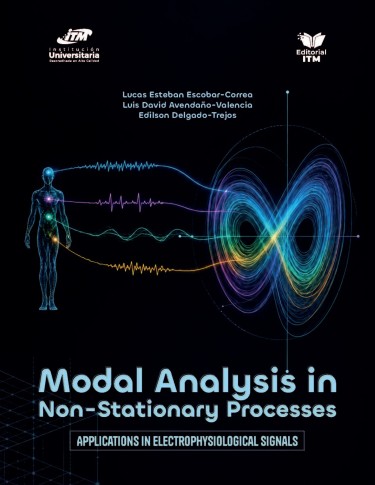
Modal Analysis in Non-Stationary Processes
Compartir en redes sociales

Modal Analysis in Non-Stationary Processes

Applications in Electrophysiological Signals

Formatos

Formatos

Estado: Activo
ISBN-13: 9786287751552
DOI: 10.22430/reporte.8299
Tipo de restricción de uso en publicaciones digitales:
Permiso de uso en publicaciones digitales: No permitido
Idioma del texto: Inglés
Número absoluto de páginas: 97 Páginas
Tamaño del archivo: 13508008 Bytes
Tamaño del archivo: 13191.41 Kilobytes (KB)
Tamaño del archivo: 12.88 Megabytes (MB)
Tipo de edición: Nueva edición
Número de edición: 1
Ciudad de publicación: Medellín
País de publicación: Colombia
Fecha de publicación: 2026-10-01
Consulta y descarga

  1. List of Figures — p. vi
  2. List of Tables — p. viii
  3. Abstract — p. x
  4. 1 Introduction — p. 1
  5. 1.1 Justification — p. 2
  6. 1.2 Problem description — p. 3
  7. 1.3 Hypothesis — p. 4
  8. 1.4 Objectives — p. 5
  9. 1.4.1 General Objective — p. 5
  10. 1.4.2 Specific objectives — p. 5
  11. 1.5 Manuscript structure — p. 5
  12. 2 State of the art — p. 6
  13. 2.1 Empirical Mode Decomposition (EMD) — p. 7
  14. 2.2 Proper Orthogonal Decomposition (POD) — p. 9
  15. 2.3 Variational Mode Decomposition (VMD) — p. 10
  16. 2.4 Time-frequency transform — p. 10
  17. 2.5 State-space representation — p. 11
  18. 2.6 General considerations — p. 12
  19. 3 Experimental framework — p. 13
  20. 3.1 Datasets — p. 13
  21. 3.1.1 Generated non-stationary signal — p. 13
  22. 3.1.2 Electroencephalography database – Siena Scalp EEG — p. 15
  23. 3.2 Time-dependent state space modal representation — p. 16
  24. 3.3 State-Space representation estimation — p. 19
  25. 3.3.1 Extended Kalman Filter — p. 19
  26. 3.3.2 Kalman Smoother — p. 22
  27. 3.3.3 Initial conditions estimation — p. 22
  28. 3.4 State-space representation optimization — p. 23
  29. 3.4.1 Expectation-Maximization (EM) — p. 23
  30. 3.4.2 Metropolis-Hastings Markov Chain Monte Carlo — p. 26
  31. 3.5 Classification — p. 29
  32. 3.5.1 Features generation — p. 29
  33. 3.5.2 Feature selection — p. 30
  34. 3.5.3 Random Forest (RF) — p. 31
  35. 3.6 Proposed methodology — p. 32
  36. 3.6.1 Methodology for the first objective — p. 33
  37. 3.6.2 Methodology for the second objective — p. 35
  38. 3.6.3 Methodology for the third objective — p. 39
  39. 4 Results and discussion — p. 44
  40. 4.1 First objective results — p. 44
  41. 4.2 Second objective results — p. 47
  42. 4.2.1 Non-stationary generated signal — p. 47
  43. 4.2.2 EEG signals. — p. 52
  44. 4.3 Third objective results — p. 54
  45. 5 Conclusions — p. 63
  46. 6 Future work and recommendations — p. 65
  47. 7 Intellectual property — p. 66
  48. 8 Impacts — p. 67
  49. 9 Conflicts of interest — p. 68
  50. Bibliography — p. 69

  • SCI055000 CIENCIA > Física > General (Principal)
  • 621.3 Tecnología (ciencias aplicadas) > Ingeniería y operaciones afines > Física Aplicada > Eléctrico, electrónico, magnético, comunicaciones, ingeniería informática; iluminación (Principal)
Nombre invertido: Escobar-Correa, Lucas Esteban
Género: Masculino
Afiliación profesional:
Afiliación Posición profesional
AMYSOD Lab, Institución Universitaria ITM
  • Prof. / Eng, MEng
Nombre invertido: Avendaño-Valencia, Luis David
Género: Masculino
Afiliación profesional:
Afiliación Posición profesional
University of Southern Denmark (SDU)
  • Prof. / Eng, MEng, PhD
Nombre invertido: Delgado-Trejos, Edilson
Género: Masculino
Digital: descarga y online - PDF
